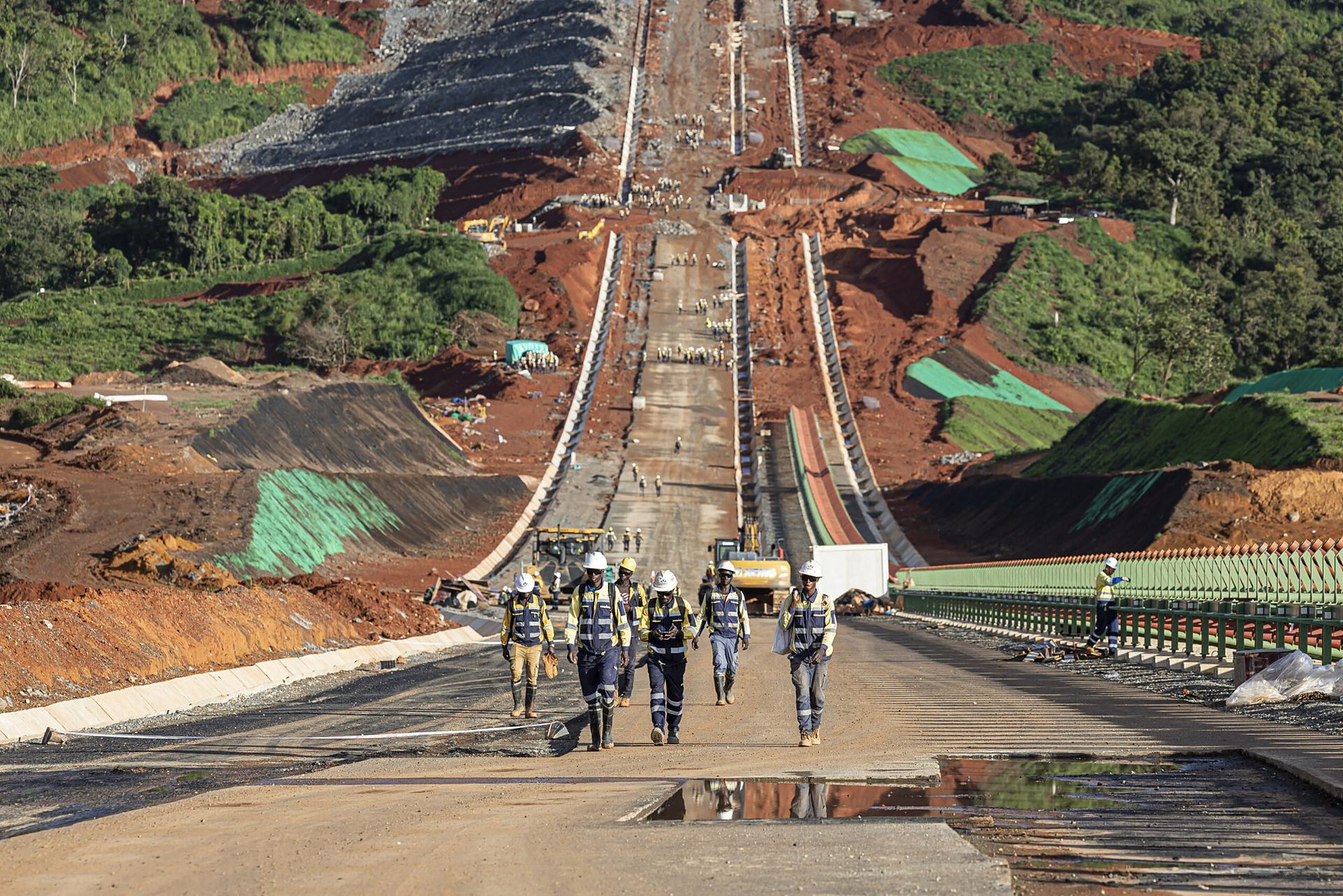
- The world's largest untapped high-grade iron ore deposit started production on 11 November 2025.
- The breakthrough came from rival consortia sharing rail and port, with the Guinean state as co-shareholder.
- Rail and port account for more than two thirds of the total cost.
- For a $20m to $200m ticket, the opportunity lies in corridor services: logistics, energy, housing, supply, maintenance.
An exceptional deposit, blocked for decades
Simandou is the world's largest untapped high-grade iron ore deposit. It is split into four blocks held by rival consortia. For decades, disputes over permits, financing and infrastructure ownership prevented any start.
| Date | Milestone |
|---|---|
| 1997 | Deposit discovered by Rio Tinto |
| 2010 | Chinalco enters the southern blocks with $1.35bn |
| 2019 | WCS consortium obtains the northern blocks |
| October 2025 | First ore loaded on the railway |
| 11 November 2025 | Official start of production |
The strategy that unlocked it
The key was to stop thinking project by project. Rival consortia share a single rail and port system: SimFer, owned 53% by Rio Tinto and 47% by Chinalco, and Winning Consortium Simandou, with the Guinean state as co-shareholder. Rail and port account for more than two thirds of the cost, hence the importance of sharing them.
The state played an active role: Guinea imposed its co-development terms during construction, notably refusing, according to the press, a delivery of Chinese locomotives.
Megaprojects move when infrastructure is shared and political interests converge. A host state in a strong position uses it.
The results
Production started on 11 November 2025 and the first ore left for China. SimFer plans a 30-month ramp-up, exporting through the WCS port until its own port is completed. At full ramp-up, nameplate capacity reaches 120 Mt a year.
Guinea in the AfriCand Index
| Indicator | Value |
|---|---|
| Rank in the AfriCand Index 2027 | 14th of 52, score 59.1, core market |
| GDP 2026 (IMF) | $45bn |
| Projected average growth 2026-2028 | 8.3% a year, the highest of tier-1 markets |
| Public debt 2026 | 35% of GDP |
| Sovereign rating | S&P B+ |
Its rank is the most sensitive to weighting among core markets: read it with caution, but the growth momentum is real.
Where the opportunities are for mid-sized investors
- Logistics and transport along the line and around the ports.
- Power generation and distribution for sites and communities.
- Housing and services for workers.
- Food supply and local processing.
- Industrial maintenance and technical services.
- Do not try to invest in the mine, but in the needs it creates.
- Analyse the ramp-up timetable to size services.
- Build country-risk sensitivity into the financing structure.
- Caixin Global (November 2025)
- SteelOrbis (September and October 2025)
- World Energy citing Reuters (October 2025)
- IMF, World Economic Outlook, October 2026
- AfriCand Africa Outlook 2027, Part VI and country profiles
Figures quoted come from official and institutional sources published in 2025 and 2026, compiled in the AfriCand Africa Outlook 2027.