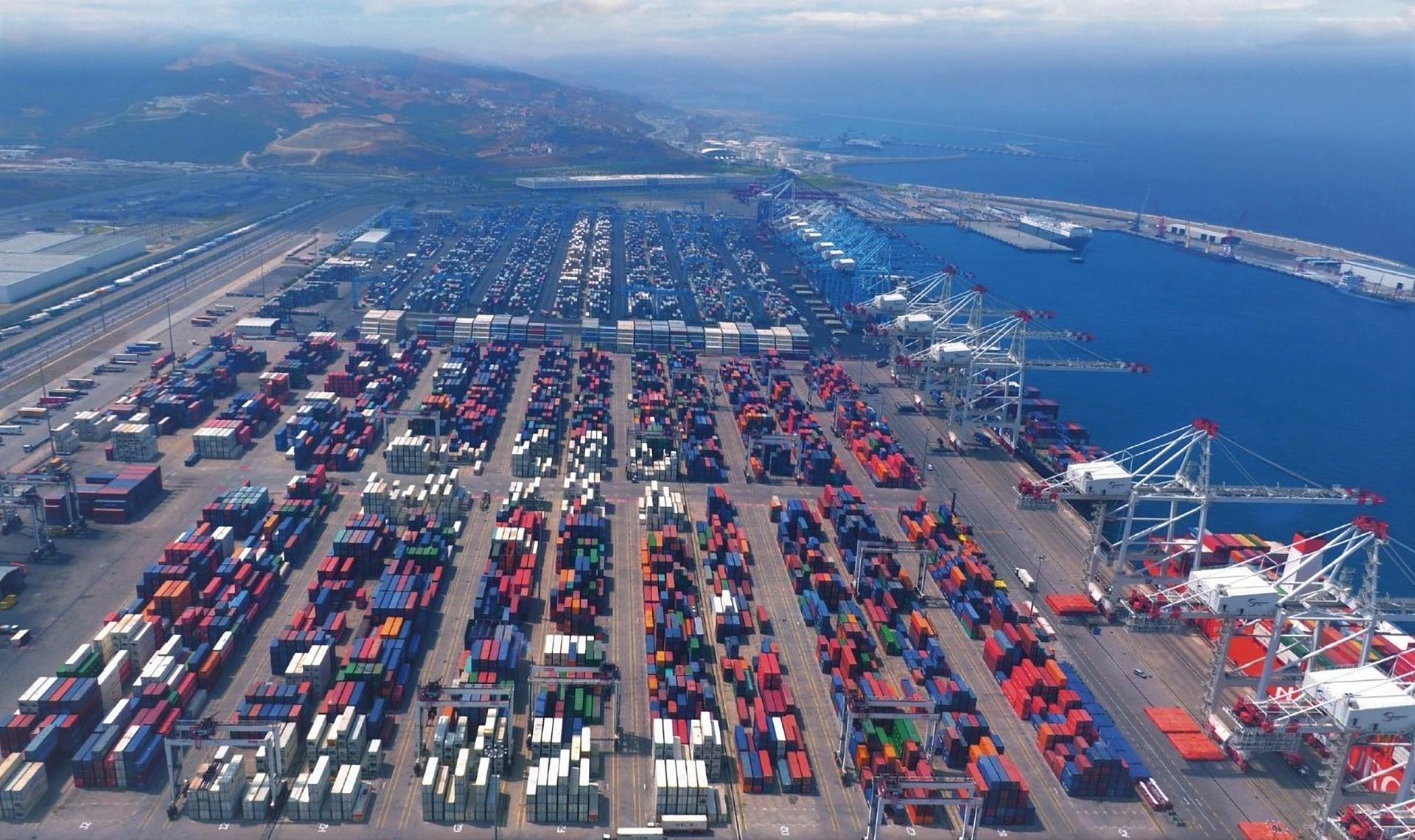
- A state that stays committed, through ownership, a concession or a contract.
- Infrastructure owned or controlled: the asset linking the project to its market sets its timetable.
- Risks priced before signing: guarantees, political risk insurance and phased commitments.
- When one of these three pillars is missing, the project pays.
Six projects, one grid
| Project | Country | Deciding factor | Status |
|---|---|---|---|
| Tanger Med | Morocco | Committed state; port and zones designed together, delivered in phases | Operating, 11.1m TEUs |
| M-PESA | Kenya | Enabling regulator; agent network as infrastructure | Operating, KES 182.7bn revenue |
| Lake Turkana | Kenya | Public grid delivered late; guarantee and deemed energy | Operating, 310 MW |
| Simandou | Guinea | Assertive state; shared rail and port | Ramping up, 120 Mt/yr targeted |
| Mozambique LNG | Mozambique | Security risk; equity replaced export credit | Under construction, first LNG expected 2029 |
| Glo-Djigbé | Benin | Partnership with the state; development finance equity | Operating, 1,640 ha |
Condition 1: a state that stays committed
At Tanger Med, a public port authority awards terminals to global operators, including APM Terminals for TC4, and links the port to industrial zones hosting manufacturers such as Renault and Stellantis. Result: 11.1m TEUs handled in 2025, 131% growth since 2019, the fastest among the world's top 30 ports, and 161 Mt of cargo.
At Simandou, Guinea imposed its co-development terms and became a co-shareholder. In Benin, the state drives the Glo-Djigbé industrial policy with a private operator. In all three cases, the state stays engaged well beyond the announcement.
Condition 2: control the infrastructure linking the project to its market
Lake Turkana Wind Power is the reverse demonstration. The 310 MW, 365-turbine plant, financed for €623m, was ready in 2017. But the 428 km public line, assigned to state-owned Ketraco, was only completed in September 2019, about 381 days late because of land disputes. The deemed-energy clause forced the state to pay for power it could not receive: the Auditor General estimated claims at about KES 18bn.
Conversely, M-PESA made distribution its infrastructure: a dense network of agents and merchants, onto which payments, savings and credit were added. Around 41m active customers in Kenya and KES 182.7bn of revenue in the year to March 2026, up 13.4%. Yet the model travels poorly: in Ethiopia, Safaricom has invested more than $1.2bn and the subsidiary is still loss-making.
Interface risk, from the grid to roads and land, often lies outside the sponsor's control. It must be priced, guaranteed or brought into the project's scope.
Condition 3: price the risks before signing
Mozambique LNG, a 13 Mt-a-year plant led by TotalEnergies, was frozen from April 2021 to November 2025 after the Palma attack. The UK and Dutch export credit agencies withdrew and partners replaced about 10% of external financing with equity. The restart budget reaches $20.5bn, against about $20bn initially, and first LNG is expected in 2029.
The lesson applies to every investor: security is a line in capex and financing, not a footnote. In fragile areas, political risk insurance and phased commitments turn unknown risks into costs lenders can accept.
The investor's checklist
- What is the state's concrete commitment: ownership, concession, contract, guarantee?
- Who builds and controls the connecting infrastructure, and on what timetable?
- Which interface risks (grid, land, roads) are not covered?
- Which guarantees or insurance can be mobilised?
- Is the financing signed, or only pledged?
- Assess a project on its ability to execute as much as on its potential.
- Require an interface-risk review in any energy or infrastructure diligence.
- Count financing only once the term sheet is signed.
- Tanger Med Port Authority, 2025 activity report (2 February 2026); El Estrecho Digital citing Alphaliner (March 2026)
- Safaricom FY2026 results (7 May 2026)
- IJGlobal; Business Daily Africa; The Star; Kenyans.co.ke citing the Auditor General
- Hydrocarbon Processing (January 2026); JPT (October 2025); World Oil citing Bloomberg
- Sources of the Simandou and Glo-Djigbé cases
- AfriCand Africa Outlook 2027, Part VI
Figures quoted come from official and institutional sources published in 2025 and 2026, compiled in the AfriCand Africa Outlook 2027.